Goods and Services Tax (GST) in India: Updated Guide for 2026
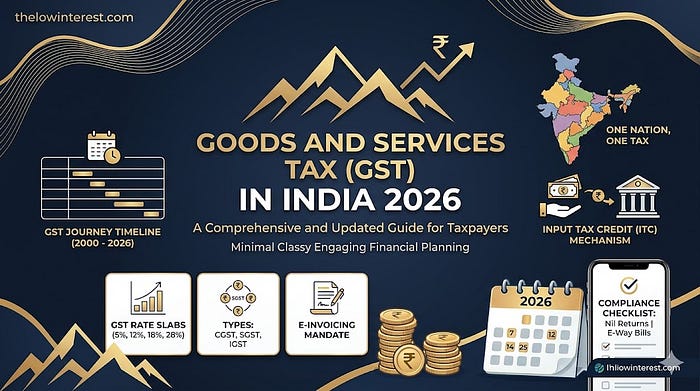
The Goods and Services Tax (GST) has transformed India’s indirect tax system by bringing multiple taxes under one unified framework. As we move into 2026, GST continues to evolve with tighter compliance, increased digitisation, and smarter enforcement, making it important for taxpayers to stay updated.
This guide explains GST basics, latest updates, compliance changes, and smart GST tips for 2026.
GST is an indirect tax imposed on goods and services where tax revenue is collected at the place of consumption. It replaced multiple indirect taxes such as VAT, service tax, and excise duty to eliminate tax-on-tax and simplify compliance.
Key Features of GST
- Implemented on 1 July 2017
- Uniform tax system across India
- Reduces cascading effect of taxes
- Fully digital & compliance-driven
- Applicable on both goods and services
GST Tax Slabs (2026)
GST continues to operate under four main slabs:
- 5% — Essential goods & services
- 12% — Standard items
- 18% — Most goods & services
- 28% — Luxury and sin goods
Outside GST (Still in 2026)
- Petroleum products (temporarily)
- Alcohol for human consumption
- Electricity
- Certain tobacco products (partially)
GST Governance: GST Council
The GST Council oversees all GST-related decisions.
Composition:
Union Finance Minister (Chairperson)
State Finance Ministers
UT representatives
The Council periodically revises rates, compliance rules, exemptions, and thresholds.
Types / Components of GST
1️⃣ CGST (Central GST)
- Levied by the Central Government
- Applicable on intra-state supply
2️⃣ SGST / UTGST
- Levied by State or Union Territory
- Collected on intra-state supply
3️⃣ IGST
- Levied by the Central Government
- Applicable on inter-state supply & imports
- IGST is later shared between Centre & State
History of GST: Quick Timeline
Year
Key Event
2000
Kelkar Task Force proposed GST
2006
GST proposed for April 2010
2011
Constitution Amendment Bill introduced
2014
GST Bill reintroduced
2016
Constitution (101st Amendment) passed
2017
GST laws implemented (1 July 2017)
Objectives of GST
🔹 One Nation, One Tax
Uniform taxation across India to create a common national market.
🔹 Input Tax Credit (ITC)
Tax paid on purchases can be adjusted against output tax, reducing costs.
🔹 Simplified Compliance
Digitisation reduces paperwork and improves transparency.
Major GST Compliance Systems
1️⃣ E-Way Bill
- Mandatory for movement of goods above ₹50,000
- Increased AI-based checks in 2026
- Auto-blocking for repeat defaulters
2️⃣ E-Invoicing
- Mandatory for businesses above notified turnover limits
- Auto-populates GSTR-1
- Reduces fake invoice risks
GST Before vs After: Key Differences
Parameter
GST Regime
Pre-GST Regime
Laws
Single GST law
Multiple state & central laws
Tax Structure
CGST + SGST / IGST
VAT, CST, Excise, Service Tax
Cascading
Minimal
High
Compliance
Digital & centralised
Fragmented
Tax Burden
Lower & transparent
Higher
🔐 Secret GST Tips for 2026 (Highly Useful)
✅ 1. Match GSTR-2B Before Claiming ITC
Only claim ITC that appears in GSTR-2B. Mismatches are the #1 reason for notices in 2026.
✅ 2. Avoid Fake ITC Traps
GST authorities now use AI & data analytics. Claiming fake ITC can lead to:
- ITC reversal
- Interest + penalty
- GST registration suspension
✅ 3. Small Businesses: Use QRMP Smartly
If eligible, use the QRMP scheme to reduce monthly compliance pressure.
✅ 4. Keep Buffer Balance for EMIs & GST
If GST payment date falls near bank holidays, ensure sufficient balance to avoid late fees & interest.
✅ 5. Timely Nil Returns Matter
Even nil returns must be filed. Non-filing can block:
- E-way bills
- Refunds
- Future ITC
GST Penalties & Interest (2026)
- Late fee: ₹50/day (₹20/day for Nil returns)
- Interest: 18% per annum
- Fraud cases may attract penalty up to 100% of tax
Frequently Asked Questions (FAQs)
1.What is GST?
GST is a unified indirect tax on the supply of goods and services in India.
2.What is the full form of GST?
Goods and Services Tax.
3.What are the types of GST?
CGST, SGST/UTGST, and IGST.
4.Who collects IGST?
The Central Government collects IGST.
5.Can GST be paid online?
Yes. GST payments are made online via the GST portal using net banking, UPI, or challans.
6.How is GST calculated?
GST is calculated as a percentage of the transaction value, based on the applicable slab (5%, 12 %, 18%, or 28%).
conclusion
GST in 2026 is no longer just about paying tax — it’s about compliance accuracy, timely filing, and smart planning. Staying updated helps avoid penalties, protect cash flow, and run your business smoothly.
At thelowinterest.com, we simplify complex financial topics so you can make smarter money decisions.

.png)

Comments
Post a Comment